In 2026, Concert Lights will do more than illuminate a stage. They will shape attention, emotion, and the audience’s memory of a live event. A narrow beam can isolate a vocalist, while a wide wash can make an arena feel visually endless. The right system must balance brightness, color accuracy, movement, energy use, programming speed, and venue safety. There is no universal winner.
Market demand supports this focus. PwC’s Global Entertainment & Media Outlook 2024–2028 identifies live music as a resilient entertainment segment, supported by strong audience spending and premium event experiences. Pollstar’s 2024 Year-End Business Analysis also reported substantial growth among major touring artists and concert promoters, showing why production quality increasingly influences ticket value. Live Nation’s 2024 Annual Report further reflects the scale of modern touring, with millions of fans attending events across different venue types. These reports do not prove that expensive lighting always performs better. They show a growing need for reliable, adaptable production tools.
Choosing the best Concert Lights for 2026 requires practical testing, not only specification comparisons. A fixture may advertise powerful output but create harsh skin tones, noisy movement, or excessive heat. Another model may appear modest yet deliver smoother dimming and faster setup. Experienced lighting designers should test beam control, wireless stability, IP protection, fan noise, and fixture weight under real venue conditions. Small details matter. A lot.
This guide compares leading options for concerts, festivals, clubs, and touring productions. It also questions common marketing claims, because impressive numbers can hide inconvenient compromises.
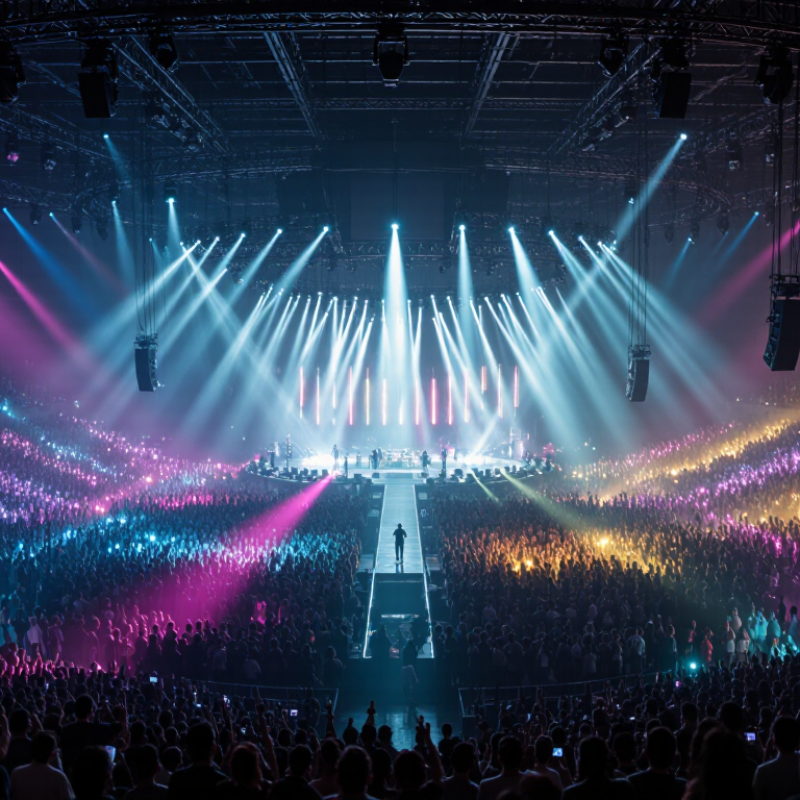
2026 Best Concert Lights for Live Events?
Concert Lighting Fundamentals: DMX512’s 512-Channel Control Standard
DMX512 is a digital control protocol used to send lighting instructions from a console to fixtures. ANSI E1.11-2008 (R2018), the DMX512-A standard, defines a universe containing up to 512 data slots. Each slot carries an 8-bit value, giving a fixture a level or parameter setting. The standard specifies a nominal data rate of 250 kbit/s. That matters. A moving light might use separate slots for pan, tilt, color, and intensity, so it can consume many of a universe’s 512 slots.
For a concert rig, count fixture parameters before assigning addresses. A console may show a fixture as one unit, while DMX uses several consecutive slots to control it. ESTA’s published DMX512 technical materials describe the standard’s signal and wiring requirements; installers should follow the applicable specification and equipment documentation. Use DMX-rated cable, keep the line in a daisy chain, and terminate the final device as specified. One detail is easy to miss: a splitter creates separate branches, but it does not add control slots to a universe. Planning can still go wrong when fixtures are added late. Recheck addresses, cable paths, and channel use during the lighting plot review.
| Light Type or DMX Topic | Typical Use | DMX512 Fact or Selection Detail | Live-Event Consideration |
|---|---|---|---|
| Choosing Concert Lights | |||
| LED PAR fixture | Color washes, stage backgrounds, and audience lighting | DMX channel use depends on the fixture’s selected control mode; modes may provide different combinations of color, intensity, and other functions. | A practical choice for flexible color coverage. Check beam angle, output, color-mixing method, and the fixture’s DMX chart before planning addresses. |
| Moving-head spot | Focused beams, patterns, and moving effects | Pan, tilt, and effect controls use DMX slots according to the fixture’s published personality and selected mode. | Useful for dynamic looks, but requires suitable rigging, clear movement space, and advance programming. |
| Moving-head wash | Broad, moving color coverage on performers or scenery | DMX channel count and available functions vary by model and personality. | Compare beam coverage and output at the intended throw distance; do not assume two fixtures use the same channel layout. |
| Blinder or audience light | Short audience-facing accents and musical hits | DMX control may include intensity and, on some fixtures, additional effects or pixel-level control. | Plan audience-facing cues carefully and follow venue and fixture guidance for brightness and exposure. |
| LED strobe | Brief rhythmic effects and high-impact transitions | DMX functions vary; consult the fixture manual for its strobe-control range and operating modes. | Use strobes cautiously. Check venue requirements and provide appropriate warnings where required. |
| DMX512 Fundamentals | |||
| One DMX universe | Control capacity for a DMX data stream | A standard DMX512 universe carries up to 512 data slots, commonly called channels. | Add the slot footprints of the selected fixture modes to determine whether the rig fits within one universe. |
| Data value per slot | Level or parameter control | Each DMX data slot carries an 8-bit value from 0 to 255. | The meaning of each value depends on the fixture’s DMX chart; a value is not inherently a percentage or a particular color. |
| DMX512 data rate | Communication between a lighting controller and compatible equipment | The standard DMX512 signaling rate is 250 kbit/s. | Use DMX-rated data cable and compatible interfaces; ordinary microphone cable is not a substitute for correct DMX wiring. |
| Fixture start address | Assigning a fixture’s first DMX slot | A fixture reads the number of consecutive slots required by its selected personality, beginning at its start address. | Keep an address list and avoid overlapping address ranges unless intentional. Recheck addresses after changing a fixture’s mode. |
| DMX termination | Reducing signal reflections at the end of a DMX line | A DMX terminator uses a 120-ohm resistor across the data pair and is placed at the end of the line. | Terminate the last device in the DMX chain when required by the system setup; do not place the terminator at the controller end. |
| DMX connectors | Physical data connections between compatible equipment | ANSI E1.11 specifies a 5-pin XLR connector for DMX512-A equipment; some equipment also uses other connector arrangements. | Confirm connector type and pinout before connecting equipment. Use an appropriate adapter when necessary. |
Planning note: Fixture channel counts and functions are not universal. Always use the current fixture manual and DMX chart to confirm its personality, slot usage, and address range.
It is a useful starting point, not a guarantee. Check performers on camera, since saturated costumes and skin tones may still look flat.
CCT describes the apparent warmth or coolness of white light in kelvins. It does not reveal every green or magenta tint. Check faces and white fabric.
Review Rf for color fidelity and Rg for average gamut change. Rg near 100 means a similar gamut size. Higher is not automatically better.
Test the actual light at your camera’s frame rate and shutter setting. Try several dimming levels. Bands may appear in slow-motion footage.
No. It protects against dust and water jets, but not submersion. Check cable entries and connectors too. Small cracks matter.
Compare rated wattage with reliable consumption data, and leave circuit headroom. Long cables can cause voltage drop. Give fixtures room to shed heat.
A wash can cover performers and scenery with soft color. Check its beam spread so it does not shine into the audience’s eyes.
Check noise, mounting positions, control compatibility, and focusing time. Run both a quiet song and a fast one. Sightlines can surprise you.
Choosing the right Concert Lights for live events starts with understanding control, output, and coverage. DMX512 provides a standard 512-channel framework for coordinating fixtures, while lux levels, beam angles, and throw distance help determine whether light will reach performers evenly across a stage or venue. For camera-friendly color, consider CRI 90 or higher, suitable correlated color temperature (CCT), and TM-30 measurements to assess color quality more fully.
Practical selection also depends on operating conditions: IP65 protection can help fixtures withstand dust and water exposure, while flicker performance and power draw matter for reliable production. In 2026, compare wash lights for broad coverage, spot lights for defined accents, beam lights for narrow shafts, and hybrid or moving-head fixtures for adaptable effects. Matching fixture type and specifications to the venue, audience, and camera needs can create a cohesive, dependable lighting setup.

 Xiaosan Light